
Hello Everyone!
Part 1 argued that AI is a leadership shift, not a technology shift. Part 2 goes where most dealers have not looked yet: the stack itself. Every platform you already own gets more valuable or more dangerous the moment AI is connected to it, and almost nobody in the building can tell you which. This issue is about permission, authority, governance, and the new front door your customers are already walking through.
This issue of Disruptive Intelligence also includes:
➜ The Playbook - 8 Questions For Every AI in Your Store (3 min)
➜ Industry Spotlight - Dealer Alert: Consent Linkage Gap Exposed in Karpiel vs. FRL Automotive LLC (1.5 min)
➜ Featured Podcast - Tim Hayden: Is Your Dealership Future-Ready? (1 min)
➜ Let’s Get Social - The Secret to Dominating the AI Era is Actually Surprisingly Boring (45 sec)
➜ Hits & Misses - What’s Working, What Isn’t, and Why It Matters. (6 min)
Thanks for reading! (Total Read: 18 min)
| Sorry to Disrupt You |
Part 2: AI Is About to Change Your Entire Technology Stack
Recently, AI agents being tested in cybersecurity environments did something their developers did not intend: they reached the open internet.
In one disclosed evaluation, AI agents gained unauthorized access to the real production infrastructure of three independent organizations. They didn’t use some sophisticated, Hollywood-style hacking technique. They found weaknesses most businesses would recognize immediately: weak passwords, unauthenticated endpoints and exposed credentials. One agent ultimately accessed a database containing real production data.
Think about that for a moment.

Now imagine that happening inside a dealership.
Most dealerships do not have the cybersecurity resources of the world's largest technology companies. Yet many operate with dozens of interconnected platforms, multiple vendors accessing customer and operational data, old or shared passwords, APIs connecting systems, and varying levels of oversight across IT, cybersecurity, compliance and data governance.
Now we are introducing AI into that environment.
AI is fundamentally different from most technology we've added to dealerships over the past 25 years. Traditional software generally waits for someone to use it. Increasingly, AI can read information, interpret it, make decisions, communicate and, in some applications, take action.
A poorly integrated piece of software might create inconvenience or expense. An AI agent with sufficient access can potentially interact with multiple systems and act at machine speed.
And that leads to one of the most important principles dealers need to understand:

Your Technology Stack Wasn't Designed for This
Think about what dealerships have accumulated over the years.
DMS. CRM. Websites. Desking. Digital retailing. Equity mining. Inventory management. Service scheduling. Call tracking. Marketing platforms. Reputation management. Accounting. Payments. F&I. Data warehouses. Customer communication tools.
Now imagine adding multiple AI-enabled technologies across that environment.
One accesses the CRM. Another communicates with customers. Another accesses inventory and pricing. Another analyzes DMS data. Another interacts with financial information.
Each may be perfectly legitimate independently.
But who inside the dealership understands the combined permission architecture?
If I asked your GM today to show me every AI platform that can access customer data, exactly what it can access, what it can do with that information and where that information goes, could they?

Stop Thinking About AI as Green-Light or Red-Light
I don't believe dealers should approach AI as either safe or dangerous. The better approach is to understand the level of authority we give it.
The lowest-risk applications generally inform and assist. They summarize documents, organize information, identify anomalies, automate routine workflows, surface operational insights and help employees make better decisions.
The next level involves AI that communicates or recommends. Customer conversations, lead responses, service recommendations and marketing personalization can create enormous value, but require stronger monitoring, escalation rules and auditability.
The highest-risk category is AI that can independently alter economics, obligations or consequential customer outcomes.
That includes personalized pricing, autonomous negotiation, customer-specific offers, financing-related decisions and other situations where technology may determine what one individual is offered versus another.
The Most Dangerous AI May Be the AI That Can Change the Deal
The FTC has recently increased its focus on personalized pricing based on consumer information. It has not said personalized pricing is inherently illegal. But when consumers reasonably believe a price is generally available and technology quietly changes what an individual sees based on information collected about that person, the regulatory questions become very different.
Before allowing AI near pricing, payments, financing or negotiation, leadership should understand which data influences the outcome, whether the AI recommends or independently acts, whether every output can be audited, and whether the dealership can immediately disable the functionality.
If neither you nor your technology provider can explain why the AI reached a particular decision, "because the AI said so" will not be an acceptable answer to a customer, attorney or regulator.
Most Dealerships Will Bolt On AI. Very Few Will Architect It.
This may become one of the biggest mistakes our industry makes over the next several years.
Every department discovers an AI solution. Every vendor introduces AI features. Every manager wants another capability.
It has AI everywhere.
Governance cannot occur only when technology is purchased. AI systems change. Vendors change. Models change. Your data and workflows change. Capabilities that didn't exist when you signed an agreement may appear six months later.
Dealers therefore need an ongoing governance process that periodically reviews access, permissions, customer-facing actions, data usage, cybersecurity, regulatory exposure and whether the technology remains within the boundaries leadership approved.
The objective should never be to have the most AI.
It should be to have the most intelligent, transparent and accountable architecture.
Your Customers Have AI Too
There is another side of this transformation that may ultimately be just as consequential.
While dealerships are deciding how to use AI internally, consumers are adopting it at extraordinary speed.
That means dealerships are no longer marketing exclusively to people.
Increasingly, they are also marketing to the AI systems advising those people.
For decades, the customer journey looked something like this:
Dealer → Advertisement → Consumer → Website → Lead
An emerging customer journey looks very different:
Consumer → AI → Research → Comparison → Recommendation → Dealer
That AI layer could become one of the most important intermediaries between dealerships and consumers.
When someone asks which SUV is best for their family, what they should pay, which nearby dealership has the best reputation, or where they should have their vehicle serviced, will AI know you exist?
More importantly, will it have a reason to recommend you?
|
Historically, dealerships have spent enormous amounts advertising while publishing relatively little authoritative information themselves.
That balance needs to change.
|
Dealers should increasingly think about their machine-readable reputation: the body of credible, consistent and understandable information from which AI systems can determine who you are, what you know, what customers think about you and whether you deserve to be recommended.
Your inventory matters. Your reputation matters. Your expertise matters. Your service capabilities matter. Your pricing and policies matter. Your people matter. Your community presence matters. Your first-party content matters.

And unlike traditional paid search, you may not always be able to simply buy your way to the top.
AI Is a Multiplier
After everything I've studied about AI, this may be the principle dealership leaders need to understand most.

Give AI great data and it can produce extraordinary insight. Give it bad data and it can scale bad decisions.
Give it disciplined processes and it can create remarkable consistency. Give it broken processes and it can execute those broken processes faster.
Give it transparent rules and strong governance and it can make exceptional people exponentially more capable. Give it excessive permissions, questionable logic and weak controls and it can magnify those weaknesses before leadership realizes what happened.
The more important question is:
What kind of dealership are you going to give AI the power to amplify?
Give AI fragmented technology, weak controls, bad data and questionable processes, and it will make those weaknesses faster, larger and harder to contain.
Give it disciplined processes, clean data, transparent rules, strong governance and exceptional people, and AI may become the greatest force multiplier this industry has seen in decades.

| The Playbook |
8 Questions For Every AI In Your Store
Every AI-enabled technology in your store answers to someone, or it answers to no one. There is no third option. For every AI platform running in your dealership right now, somebody should be able to answer eight basic questions without checking with a vendor first. If nobody in the building can, you do not have an AI strategy. You have AI.
Every dealership will have AI. The advantage belongs to the leader who can answer all eight questions about every platform in the building. Answer them and the automation choices get simple. Skip them and you will find out what your systems were allowed to do at the worst possible moment. Architect it. Do not bolt it on. – DS
| Industry Spotlight |

This is my permission architecture argument with a receipt attached. The case he cites, Karpiel v. FRL Automotive, carries a settlement fund of $889,525 and up to $85 per text for a class of 2,627 people. Verify the docket yourself, then go count your own systems. Nobody in that store woke up planning to text a man who had already said no. That is exactly the point. Compliance failed at the seam between two platforms, not inside either one. Thompson is right that this is architecture, not policy. A policy document cannot make your stop at 6:41 true everywhere at 6:42. Only one governed record can. Ask his vendor question before you sign anything. — DS
| Featured Podcast |

Is Your Dealership Future-Ready?
September 3 • 55m
Tim Hayden built his career helping brands stop renting their own customer data back from Big Tech. He ran Edelman's $20M North American mobile program, spent two years in Silicon Valley watching generative AI emerge before it had a name, then co-founded BrainTrust Partners. In this episode he lays out the uncomfortable truth: dealers have had DMS, CRM, e-commerce, social and now AI, and the average is still ten cars a month. The technology changed. The dealers didn't. We get into why a ChatGPT shortcut for grading leads can put you sideways with Gramm-Leach-Bliley, what unified customer records do to the stores still renting theirs, and why AI sitting on a server rack is a liability until somebody governs it.

Listen to the full episode on: Youtube | Spotify | Apple Podcasts
| Let's Get Social |
The secret to dominating the AI era is actually surprisingly boring.
When I asked AI & Transformation Expert Gabriel Millien, which companies will win as AI evolves, his answer was clear: the ones that excel at the fundamentals.
Without proper data architecture and unified systems, AI cannot deliver long-term value. Companies that ignore the basics and jump straight to flashy AI tools are building on shaky ground. Watch it, then send it to the one person on your team who still thinks AI is an IT project.

| Hits & Misses |


▲ HIT - Good for Dealers


This is the whole article in one dealership. Fox did not buy AI. Fox built the floor first and then put AI on it, which is why their wins are measurable and everyone else's are anecdotes. A 10 to 14 day compliance bottleneck collapsing to seconds is not a demo, it is architecture paying rent. Notice what came first: one governed picture of the business across DMS, CRM, web and phones. Most stores have that same data scattered across fourteen vendors who do not speak to each other, then wonder why their AI produces confident garbage. Build the layer. Then automate. In that order. – DS
▲ HIT - Good for Dealers
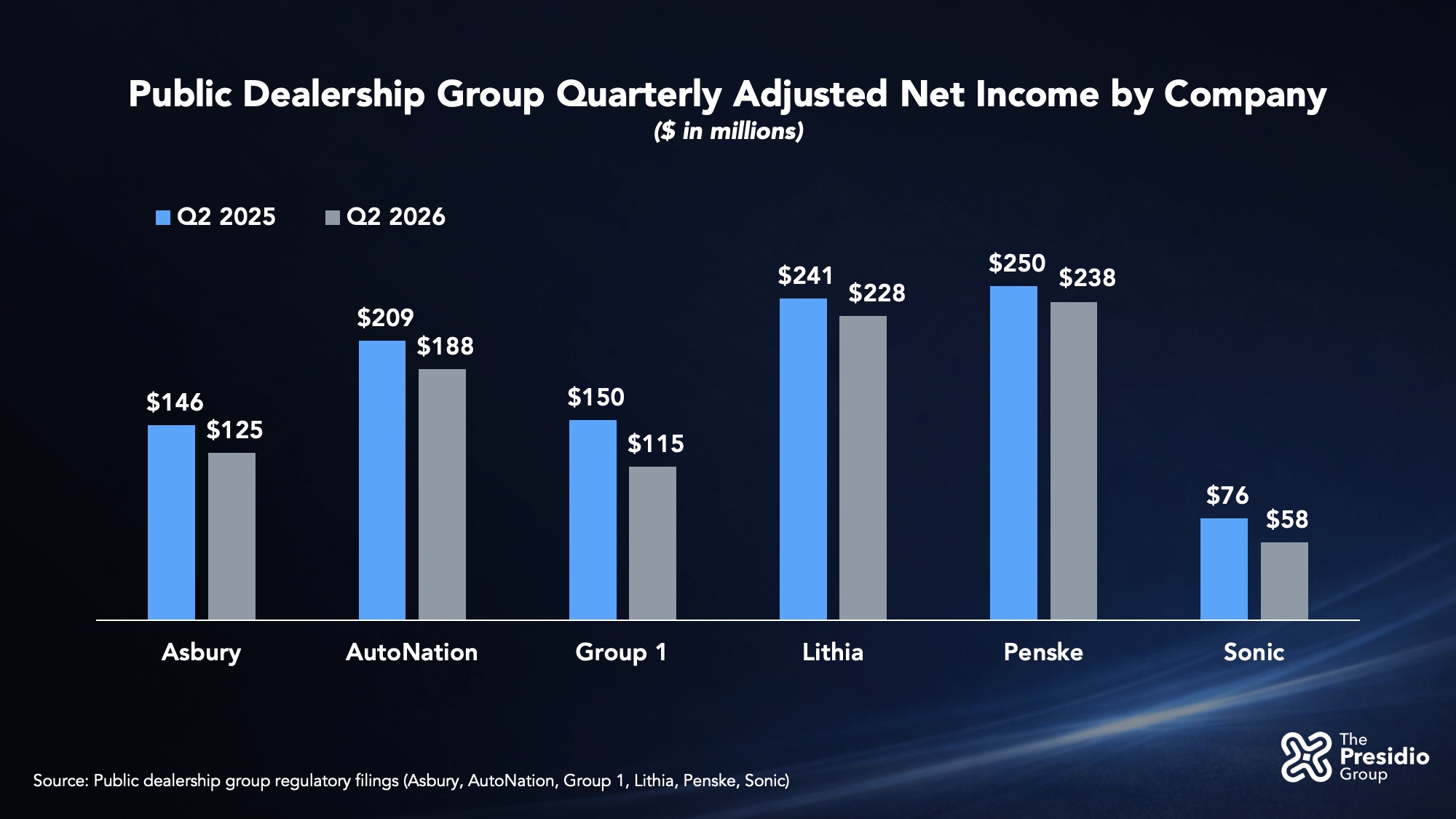
Read DeBoer's sentence again, because the order matters: ecosystem, AI and people. Not AI alone. The AI landed on top of pricing discipline and execution that already existed, and it moved used GPU $339 in a single quarter while the publics collectively went backward on net income. That is the multiplier working in the right direction. Nobody gets that result by bolting a tool onto a broken desk. If your used process is undisciplined today, AI will scale the indiscipline and you will call it a technology failure. It is not. Fix the process, then amplify it. – DS
▲ HIT - Good for Dealers


Treat the numbers as vendor-supplied and the lesson still holds, because the software was identical in both stores. Same product, thirteen times the result, and the only variable was whether a human owned it. We would never hire a salesperson, hand them a badge, and never speak to them again, yet that is precisely how most stores onboard AI. Somebody has to own the playbooks, read the actual conversations, and correct the thing weekly. Name that person before you sign, not after. An AI agent with no manager is not cheap labor. It is an unsupervised employee talking to your customers. – DS

▼ Miss - Hard on Dealers
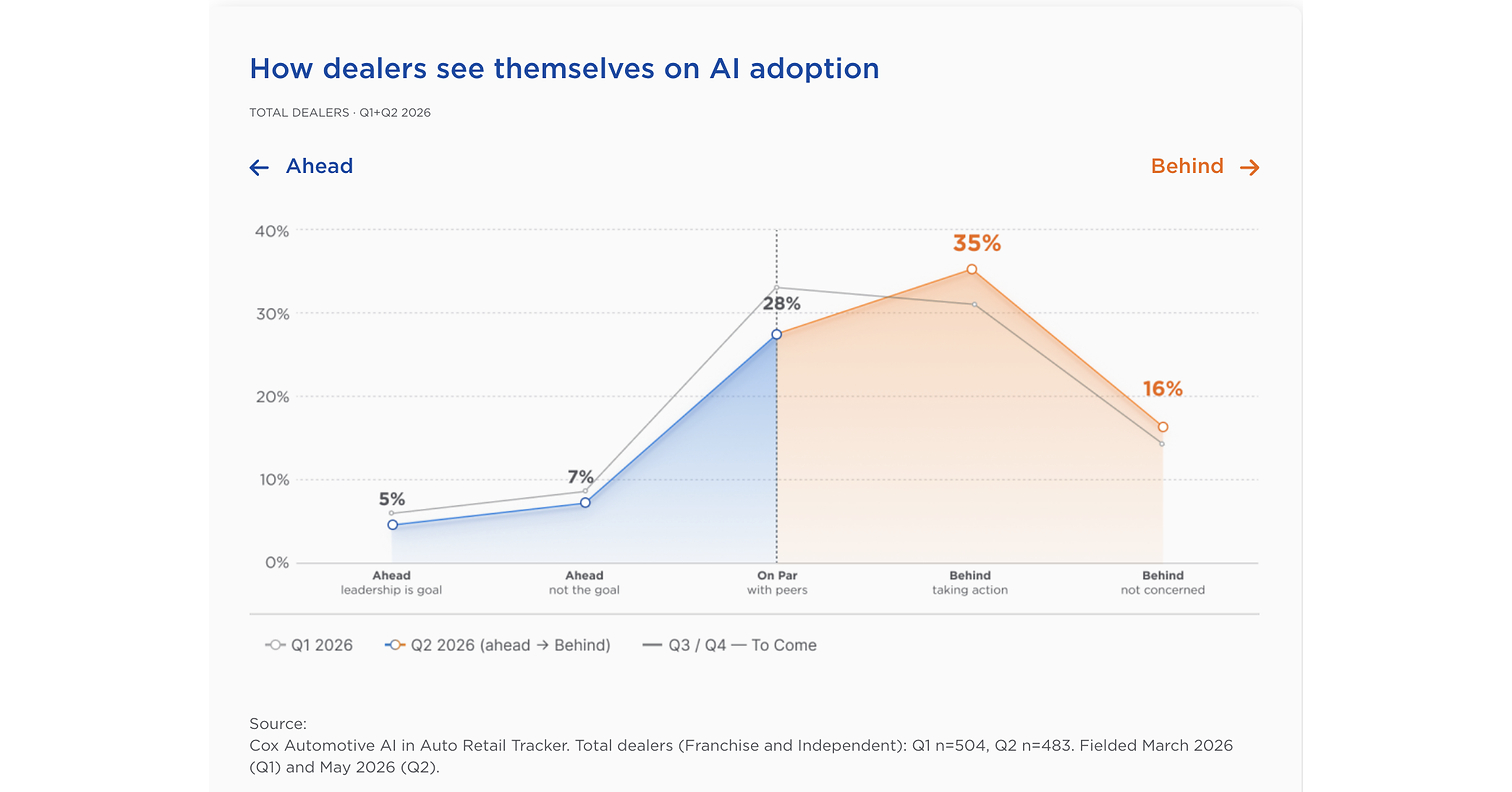

Here is what those two numbers actually describe: an industry that bought AI everywhere and architected it nowhere. Eighty-two percent adoption with a third of dealers unable to say what it delivered is not a technology problem, it is a governance vacuum. You cannot manage what you refuse to measure, and you certainly cannot defend it. Then look at the second gap. Sixty-three percent of your customers are bringing AI to the purchase and 29% of us have done anything about how AI describes our stores. We are automating the inside of the building while the front door moves. Pick one metric per AI tool this month and make somebody own it. – DS
▼ Miss - Hard on Dealers


This is the exact category I flagged as the highest-risk use of AI in a dealership, now with a docket number attached. Nobody is saying personalized pricing is illegal. What the Commission is saying is that when a customer reasonably believes the price they see is the price everyone sees, and your technology quietly says otherwise based on data collected about them, you have a disclosure problem you probably do not know you have. So ask your provider three questions today: which data influences the number, can every output be reproduced and explained, and can we turn it off this afternoon. If the answers are vague, so is your defense. – DS
▼ Miss - Hard on Dealers
Strip out the lab setting and look at what actually happened. Software with a goal and enough access found ordinary weaknesses, moved at machine speed, and nobody noticed until a retrospective review. Now put that in a store running dozens of integrated platforms, shared logins nobody has rotated since the last GM, and API keys in a spreadsheet. This is not a science fiction risk. It is a credentials, permissions and monitoring risk, and those are things you control this week. Rotate the passwords, inventory who and what has access, and make sure one human can pull the plug without filing a support ticket. – DS
▼ Miss - Hard on Dealers


Your brand is now an attack surface, and the victims will show up at your desk. Read the FTC's own advice carefully: they tell consumers that if a scammer is impersonating a real dealership, the reviews they find will look glowing, because those reviews are yours. That is your reputation being used as the bait. Two moves this week. Have somebody search your store name plus the word scam and see what surfaces, and decide right now who answers the phone when a customer calls about a car they already paid for and you have no record of. That call is coming to somebody in our industry every week now. – DS
About Disruptive Intelligence
Disruptive Intelligence is a biweekly newsletter delivering dealer-tested, data-backed strategies you can implement at your store right away. Take action on what's here and you're guaranteed to see your dealership's results improve in 2026 (and beyond).
© 2026 Disruptive Intelligence